 listicle
Does Xeriscaping Look Like a Desert? Design Facts
Table of Contents
- The Desert Myth: Why Xeriscaping Gets a Bad Reputation
- What Xeriscaping Actually Looks Like in Practice
- Low Water Xeriscaping Ideas That Look Lush, Not Barren
- Xeriscaping Design Principles That Separate Lush From Empty
- Native Plants for Sustainable Landscapes: The Key to a Full Look
- Does Xeriscaping Increase Property Value and Cut Water Bills?
- HOA Rules and Permits: What to Check Before You Dig
- Frequently Asked Questions
Last Updated: September 14, 2026
The Desert Myth: Why Xeriscaping Gets a Bad Reputation
Ask most homeowners what xeriscaping looks like and you'll get the same answer: gravel, a few sad cacti, and a yard that screams "I gave up." That reputation is the biggest reason people avoid water-wise landscaping, but the desert myth is wrong.
Xeriscaping reduces or eliminates supplemental irrigation through drought-tolerant plants, efficient irrigation, and thoughtful design. The word comes from the Greek "xeros," meaning dry, and was coined by Denver Water in the 1980s. Nothing in that definition requires rocks or cactus.
A poorly planned xeriscape looks barren; a well-designed one looks like a garden. The difference isn't the water budget, it's the design.
Colorado State University Extension guide to xeriscaping
What Xeriscaping Actually Looks Like in Practice
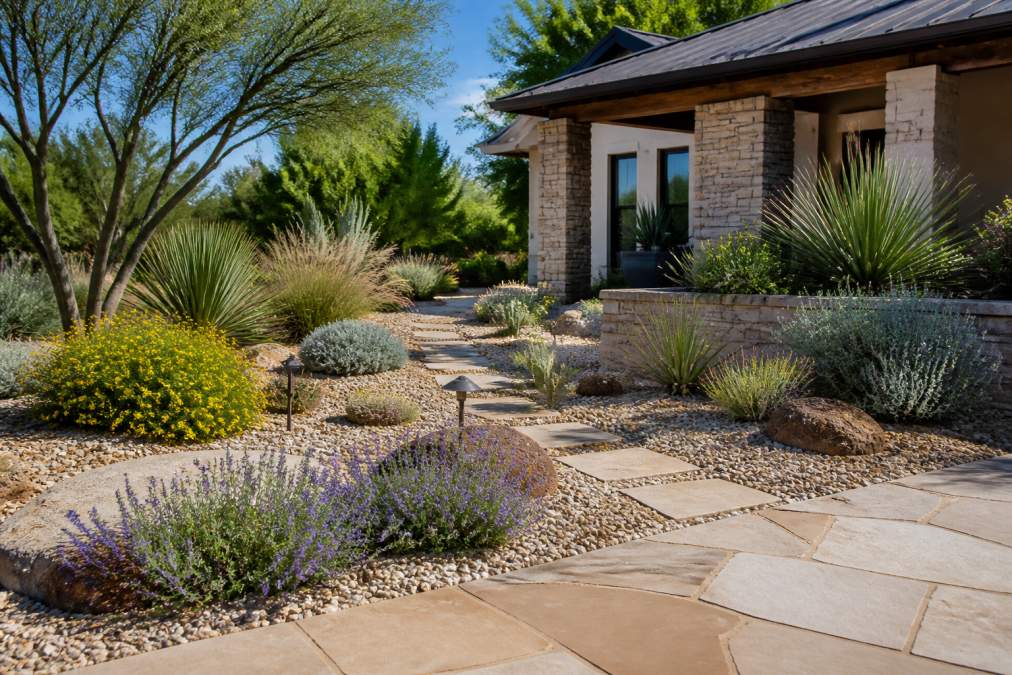
A real xeriscape looks like a layered, textured garden that happens to need less water: height, color, seasonal change, ground cover, flowering perennials, ornamental grasses, and pollinator-friendly shrubs. It looks lush in spring and holds structure in August.
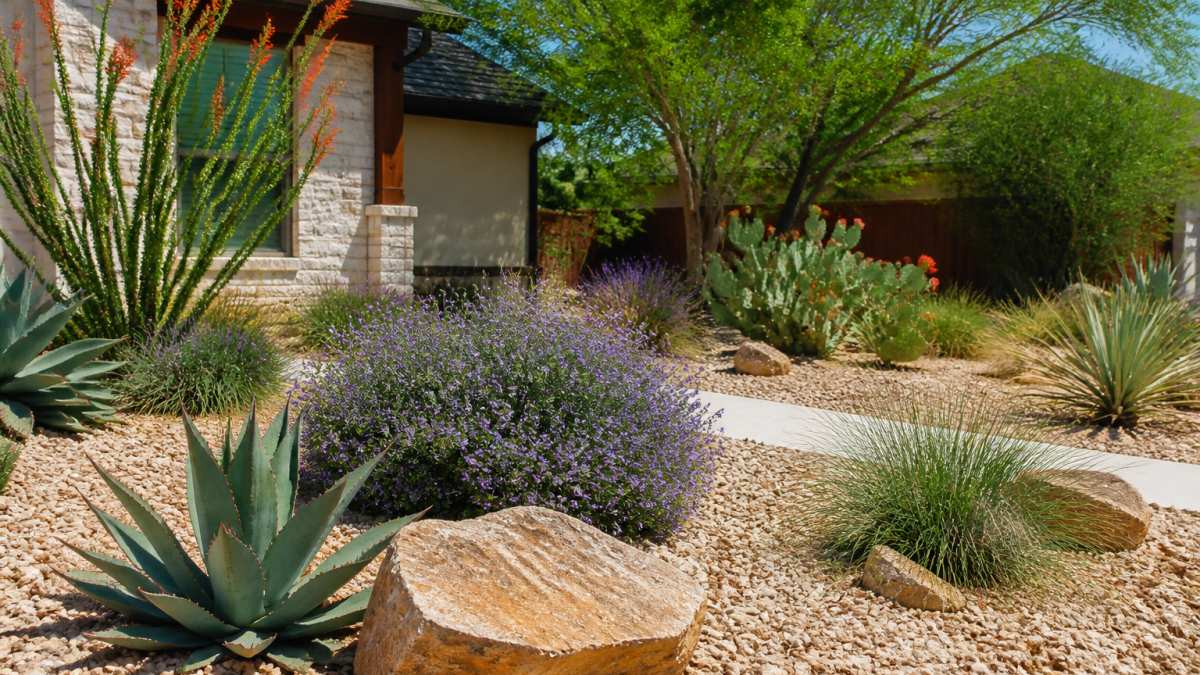
The confusion comes from conflating xeriscaping with "zero-scaping," the gravel-and-boulders approach that strips a yard bare. Zero-scaping removes plants; xeriscaping replaces thirsty plants with climate-adapted ones.
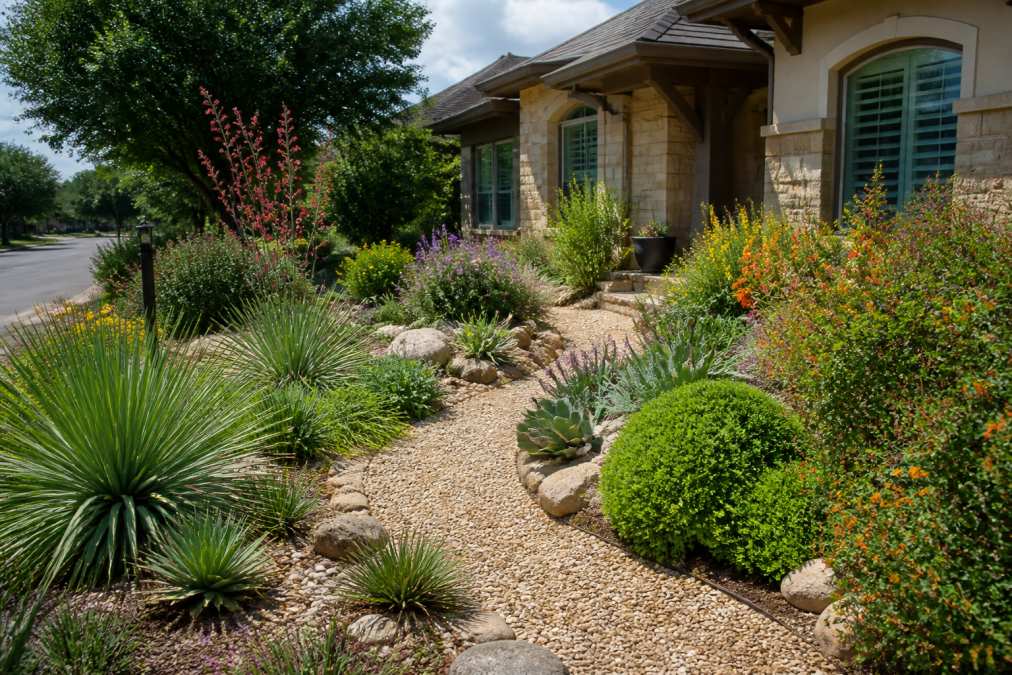
From Turf Removal to Full Canopy
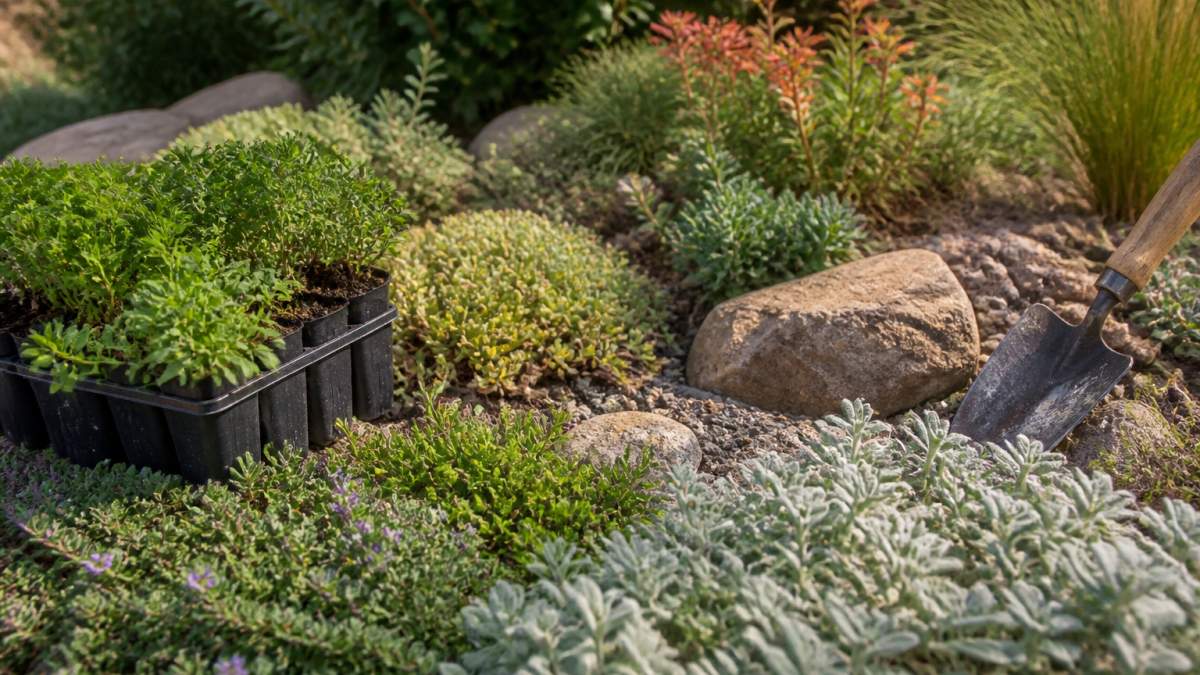
The transformation happens in stages. Remove or shrink the turf, then amend the soil, because most native and desert-adapted plants need drainage, not rich, water-holding ground. Next comes the planting layer: ground cover at the front, mid-height perennials behind it, shrubs and small trees for the canopy. Finally, add mulch or gravel to hold moisture and define the beds.
Skip any of those layers and you get the desert look everyone fears. Do all four and you get a garden.
Low Water Xeriscaping Ideas That Look Lush, Not Barren
The best low water xeriscaping ideas lean on contrast, not volume. A single bold agave against fine-textured grasses reads as intentional. A wall of one plant reads as empty. Mix leaf sizes, colors, and heights so the eye has somewhere to travel.
Ornamental grasses are the workhorse: they move in the wind, soften hardscaping, and need little water once established. Pair them with flowering natives like salvia, lantana, or blackfoot daisy for color from spring through fall.
Layering for Depth and Color
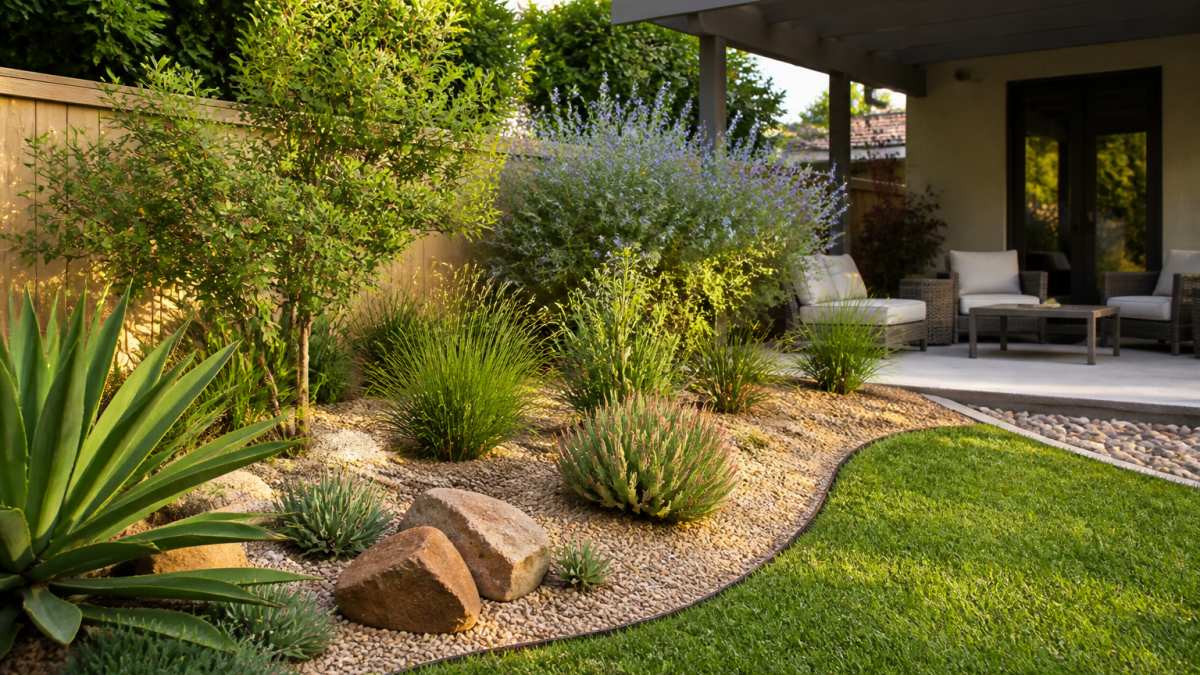
Think in three tiers: ground, middle, and canopy. The ground tier uses low growers and mulch. The middle tier carries the color. The canopy tier adds height and shade. When all three are present, even a small yard reads as full.
Xeriscaping Design Principles That Separate Lush From Empty
The design principles behind a good xeriscape are the same as any good garden, only the plant palette differs. Group plants by water need, repeat shapes and colors, and let hardscaping do structural work instead of filling space with gravel.
What separates a lush xeriscape from an empty one comes down to four moves: hydro-zoning, plant density, texture contrast, and a deliberate regional palette. Get those right and the yard reads as a garden; skip them and it reads as a gravel lot with shrubs.
Hydro-Zoning and Plant Grouping
Hydro-zoning means grouping plants with similar water needs so you can irrigate one zone heavily and leave another dry, the opposite of the traditional lawn-and-shrubs approach, where everything gets the same schedule. Zone correctly and you stop overwatering plants that don't need it and underwatering the ones that do.
A practical layout uses three zones. The oasis zone sits closest to the house and holds the thirstiest plants. The transition zone carries the bulk of the color with moderate-water perennials and shrubs. The arid zone runs along the street or back fence and uses the toughest drought-adapted plants with little to no supplemental irrigation. Shifting even a third of the planted area into the arid zone cuts outdoor water use noticeably without changing how full the yard looks from the street.
Density, Spacing, and Texture Contrast
The biggest reason a new xeriscape looks barren is underplanting. Homeowners and even some installers space plants for mature size and leave the ground bare for two or three seasons. Better: plant at the density you want now, using fast-growing fillers between slow-establishing anchors, then thin the fillers as the anchors fill in.
Texture contrast does the rest. Fine-textured plants, ornamental grasses, yarrow, penstemon, soften coarse plants like agave, yucca, or boulders. Repeating one strong shape three or five times along a bed creates rhythm. A single bold specimen against a mass of fine texture reads as intentional; the same plant alone in gravel reads as abandoned.
Regional Aesthetic Variations: What Xeriscaping Looks Like Outside the Desert
Most guides fail here, showing desert Southwest examples and leaving homeowners in temperate, coastal, or humid regions convinced xeriscaping isn't for them. It is, it just looks different.
In the Pacific Northwest, a xeriscape leans on evergreen huckleberry, Oregon grape, salal, and sedums, with a green-and-bronze palette that holds color through winter. The Southeast uses yaupon holly, beautyberry, coneflower, and native grasses that shrug off humidity and downpours. The Midwest favors little bluestem, purple coneflower, switchgrass, and native shrubs that handle drought and hard freezes. The Mountain West mixes penstemon, rabbitbrush, and native bunch grasses with gravel mulch matching local stone.
The common thread isn't cactus. It's plants matched to local rainfall, soil, and temperature swings, arranged in layers, with mulch or gravel echoing the surrounding landscape. A xeriscape in Georgia and one in Nevada share a water strategy, not a plant list.
Native Plants for Sustainable Landscapes: The Key to a Full Look
Native plants for sustainable landscapes are what make a xeriscape look alive instead of sparse. Native vegetation evolved with local rainfall, soil, and temperature swings, so it establishes faster and needs less intervention once planted.
The trade-off is patience. Natives sleep the first year, creep the second, and leap the third. Homeowners expecting instant fullness get discouraged; those who plant for the long term get a yard that fills in and stays full.
A common mistake is treating native plants as one category. A plant native to a wet bottomland won't thrive on a dry slope, even if it's native to the region. Match the plant to the microclimate, not just the zip code.
Does Xeriscaping Increase Property Value and Cut Water Bills?
Yes, on both counts, though the benefit depends on what you replace, how you maintain it, and how your utility prices outdoor use.
The Cost Side: What You're Actually Paying For
Converting a lawn to a xeriscape isn't free. The main cost categories are design, turf removal and disposal, soil amendment and grading, plant material, mulch or gravel, irrigation retrofit, and hardscape such as paths or boulders.
The range is wide because inputs vary. A DIY conversion keeping existing irrigation and using small container plants costs a fraction of a professionally designed installation with mature specimens, drip conversion, and custom hardscape. The biggest swing factor is plant size at install, larger specimens shorten the fill-in period but multiply the plant line item. The second is hardscape, often the most expensive line and the easiest to trim without hurting the look.
A useful way to think about it: the upfront cost of a xeriscape is usually higher than reseeding a lawn and lower than installing a new traditional lawn with sod, irrigation, and edging from scratch. Against an existing lawn, the xeriscape costs more today and less over time.
The Savings Side: Water, Maintenance, and Equipment
Outdoor water use is typically the largest slice of a household's warm-month water bill, and lawn irrigation is the largest part of that slice. Replacing turf with climate-adapted plants and drip irrigation cuts the irrigated area, the frequency of watering, and the waste from overspray and runoff.
Savings show up in three places. First, the water bill, especially with tiered pricing where heavy users pay a higher rate per gallon, those households see the largest percentage drop. Second, maintenance labor and inputs: no weekly mowing, less edging, less fertilizer, fewer replacement plants once established. Third, equipment: many converted yards no longer need a gas mower, string trimmer, or the fuel and upkeep that go with them.
Water and maintenance savings accumulate slowly for the first two or three seasons while plants establish, then accelerate once the landscape matures and irrigation drops to occasional deep watering. Homeowners who track their bills often find break-even arrives sooner than expected, particularly in regions with high summer water rates or watering restrictions.
Property Value: What Actually Moves the Number
Property value is harder to pin down because it depends on the local market, design quality, and how the yard compares to neighbors. A thoughtful xeriscape that matches the neighborhood aesthetic and looks maintained tends to help. A gravel pit with three cacti tends to hurt, and that's the image keeping the desert myth alive.
Three factors separate xeriscapes that add value from ones that don't. First, curb appeal: layered plants, clean edges, and clear design intent read as cared-for. Second, consistency with the neighborhood, a xeriscape that looks wildly out of place is a harder sell even if well executed. Third, documented maintenance: buyers and appraisers respond to a landscape with a plan behind it, not one that looks abandoned halfway.
A Simple Cost-Benefit Framework
Instead of guessing, run the numbers on your own yard:
- Measure the square footage of turf you'd remove.
- Look up your utility's tiered water rate and estimate the gallons per square foot your lawn uses in a typical summer month.
- Multiply to get your current monthly outdoor water cost during peak season.
- Estimate your conversion cost using local quotes for plant material and hardscape.
- Divide conversion cost by monthly savings for a rough break-even in months.
That framework won't be exact, but it turns a vague question into a number you can act on. For most homeowners replacing a significant lawn area in a tiered-rate utility, break-even lands within a few years, and the landscape keeps saving after that.
| Factor | Traditional Lawn | Well-Designed Xeriscape |
|---|---|---|
| Upfront cost | Lower if reseeding, higher if new sod and irrigation | Higher than reseeding, lower than full new lawn install |
| Peak-season water use | High, weekly irrigation | Low, deep watering less often |
| Maintenance labor | Weekly mowing, edging, seasonal fertilizer | Seasonal pruning, mulching, occasional cleanup |
| Equipment needs | Mower, trimmer, fuel, upkeep | Minimal once established |
| Seasonal color | Uniform green | Layered, changing through the year |
| Drought resilience | Poor, browns out under restrictions | Strong, holds structure and color |
| Curb appeal | Familiar | Depends on design quality and neighborhood fit |
| Property value impact | Neutral baseline | Positive when well designed and maintained |
HOA Rules and Permits: What to Check Before You Dig
Homeowners associations are the most common obstacle to a xeriscape conversion, and rules vary wildly. Some HOAs explicitly allow drought-tolerant landscaping; others have covenants mandating turf coverage or restricting plant height and hardscape materials.
Before removing a single square foot of grass, pull your HOA's architectural guidelines and read the landscaping section, then submit a design plan for approval. A professional plan with plant lists, a site map, and a maintenance outline clears approval far more often than a hand sketch. If your HOA has no drought-tolerant provision, you may be able to petition for an amendment, and many states now limit how far HOAs can restrict water-wise landscaping.
Municipal rules matter too. Some cities require permits for certain hardscape work, and some offer rebates for turf removal. Check with your local water utility before you start.
U.S. EPA WaterSense program for outdoor water use
Frequently Asked Questions
What are the downsides of xeriscaping?
The main downsides are the upfront cost of turf removal and soil prep, plus the time it takes for young plants to fill in. Some homeowners also find that xeriscapes need occasional weeding until ground cover establishes. In San Antonio's clay soils, drainage work may be needed first. None of these are permanent problems, and most are offset by lower water bills and less mowing over time. A professional design plan can help you avoid costly mistakes.
How do you make xeriscaping look lush?
Use layered plant groupings instead of single rows. Combine tall ornamental grasses, mid-size flowering perennials, and low ground cover so the eye sees depth. Add native plants with different bloom times for year-round color. Mulch with gravel or bark to unify the look, and use hardscaping like flagstone paths to break up open space. Group plants by water need so each zone stays healthy. With the right xeriscaping design principles, a yard can read as full and intentional, not sparse.
Does xeriscaping increase property value?
It can. A well-designed xeriscape improves curb appeal and signals lower maintenance to buyers, which matters in a water-scarce market. Turf removal also cuts ongoing water and mowing costs, a selling point for new homeowners. The gain depends on design quality and plant maturity. A yard that looks intentional and healthy tends to appraise better than one with patchy grass. Pairing native plants for sustainable landscapes with clean hardscaping gives the strongest return.
What are the 7 principles of xeriscaping?
The seven principles are: planning and design, soil improvement, appropriate plant selection, practical turf areas, efficient irrigation, mulching, and proper maintenance. These principles work together. Soil drainage and organic matter support root health. Hydro-zoning groups plants by water need. Mulching reduces evaporation. Efficient irrigation, such as drip lines, targets roots instead of spraying water. Following these principles is what separates a lush, low-water yard from a rocky patch.