 listicle
Best Native Ground Cover Plants for Drought in 2026
Table of Contents
- Why Native Ground Cover Plants Win in Drought
- The Benefits of Native Ground Cover
- Quick Comparison: Best Native Ground Covers for Drought
- 1. Turkey Tangle Frog Fruit (Phyla nodiflora)
- 2. Beach Strawberry (Fragaria chiloensis)
- 3. Rocky Point Ice Plant (Malephora luteola)
- 4. Creeping Phlox (Phlox subulata)
- 5. Hummingbird Sage (Salvia spathacea)
- 6. Common Violet (Viola sororia)
- How to Install Native Ground Cover for Lasting Results
- How to Choose the Right Native Ground Cover
- Frequently Asked Questions
Last Updated: October 1, 2026
Why Native Ground Cover Plants Win in Drought
Native ground cover plants are low-growing species that evolved in a specific region and survive there on local rainfall alone. That evolutionary history is the whole point: a plant that evolved in your area already knows how to handle your soil, your heat, and your dry spells without a sprinkler schedule holding it together.
At Lawnscapingsa.com, we've spent 18 years planting these species across properties, and the pattern never changes: native ground covers establish slower in year one, then need almost nothing after that. Water conservation stops being a chore and becomes a default.
If you want the short version, here are our top picks:
- Best overall: Turkey Tangle Frog Fruit, for walkable coverage that shrugs off foot traffic
- Best for slopes: Beach Strawberry, for erosion control on tricky grades
- Best for rock gardens: Rocky Point Ice Plant, for blazing sun and reflected heat
- Best for shade: Hummingbird Sage, for dry shade where grass gives up
- Best for spring color: Creeping Phlox, for a carpet of blooms on sandy soil
Below, we'll show you how to install each one, which species fit which problem, and where most homeowners go wrong.
The Benefits of Native Ground Cover
The benefits of native ground cover come down to three things: less water, less work, and more life in your yard. A native ground cover is a low-growing plant species indigenous to a region that spreads to form a living carpet, suppressing weeds and cooling soil without irrigation once established.
How Native Ground Covers Actually Save Water
The water savings are not just about skipping the sprinkler. They come from three physical mechanisms that conventional turf cannot match.
Deeper, more efficient roots. Many native ground covers, including Hummingbird Sage and Beach Strawberry, root deeper and more fibrously than turfgrass. That root mass reaches moisture that stays in the soil profile after the surface dries, so the plant draws on reserves a shallow-rooted lawn never touches.
Living mulch that shades the soil. A closed native canopy intercepts sunlight before it hits bare ground. Bare soil can lose a large share of its moisture to direct evaporation after a rain; a shaded, mulched surface holds that moisture far longer. This is why a mature native planting often needs no supplemental water at all, while an equivalent turf area needs weekly irrigation through summer.
Drought dormancy instead of drought death. Turfgrass under water restrictions goes brown and dies. Many native ground covers go semi-dormant, drop some foliage, and green back up when rain returns. That survival strategy is the difference between a landscape that recovers and one you have to replant.
Less Work, Measured in Seasons
Compare the annual calendar. A conventional lawn needs mowing through the growing season, feeding several times a year, and consistent irrigation. An established native ground cover needs an annual cutback or cleanup, occasional edging where it meets a path or bed, and nothing else. Most practitioners find the maintenance load drops to a fraction of turf care once the planting closes its canopy, usually by the second or third season.
More Life: Pollinators, Predators, and Soil
The biodiversity payoff is not a slogan. Native ground covers feed native pollinators, and a USDA Forest Service guide to pollinators explains how native plants support insect species that non-native landscaping simply can't. Beyond pollinators, a dense native mat shelters ground beetles, spiders, and other predators that keep pest populations in check, and its root network feeds soil biology that improves drainage over time.
Quick Comparison: Best Native Ground Covers for Drought
| Plant | Sun Needs | Best For | Traffic | Evergreen? |
|---|---|---|---|---|
| Turkey Tangle Frog Fruit | Full sun | Lawn replacement | Walkable | Semi-evergreen |
| Beach Strawberry | Full sun to part shade | Slopes, erosion control | Light | Yes |
| Rocky Point Ice Plant | Full sun | Rock gardens, slopes | None | Yes |
| Creeping Phlox | Full sun | Borders, rock walls | None | Yes |
| Hummingbird Sage | Part shade | Dry shade, color | None | Semi-evergreen |
| Common Violet | Sun to shade | Woodland, understory | Light | No |
1. Turkey Tangle Frog Fruit (Phyla nodiflora)
Turkey Tangle Frog Fruit is the best native ground cover for drought if you need something you can actually walk on. It spreads fast, tolerates light to moderate foot traffic, and produces small nectar-rich flowers that pollinators work all season.
This is the species we recommend most often for homeowners replacing a struggling lawn. It knits together quickly and handles the compacted, sun-baked soil that kills fescue.
The catch: in ideal conditions it can become aggressive, so give it a defined edge or a mowing strip.
2. Beach Strawberry (Fragaria chiloensis)
Beach Strawberry forms a dense mat of glossy evergreen leaves and holds slopes that would wash out under bare soil. It's durable, salt-tolerant, and produces small edible berries that wildlife get to before you do.
Where it falls short: it's slow to establish. Give it a full season before you judge it.
For slope stabilization, pair it with a NRCS conservation practice standard on critical area planting approach: plant on contour, and mulch between plugs until the mat closes.
3. Rocky Point Ice Plant (Malephora luteola)
Rocky Point Ice Plant is a succulent ground cover built for heat-stressed, xeriscaped slopes. Its fleshy foliage stores water, so it keeps going through the worst of summer, and it rewards you with a prolific yellow bloom.
This is our pick for rock gardens and areas with reflected heat off pavement or walls.
4. Creeping Phlox (Phlox subulata)
Creeping Phlox delivers the best spring color of anything on this list. It forms a dense carpet of needle-like evergreen foliage, then covers itself in star-shaped flowers.
5. Hummingbird Sage (Salvia spathacea)
Hummingbird Sage is the answer for dry shade, where most ground covers fail. It spreads through rhizomes, suppresses weeds effectively, and sends up vibrant tubular flowers that hummingbirds find immediately.
6. Common Violet (Viola sororia)
Common Violet adapts to nearly any light condition and self-seeds to fill gaps on its own. It provides early-season nectar and supports native butterfly larvae, which makes it a strong pollinator-friendly choice.
How to Install Native Ground Cover for Lasting Results
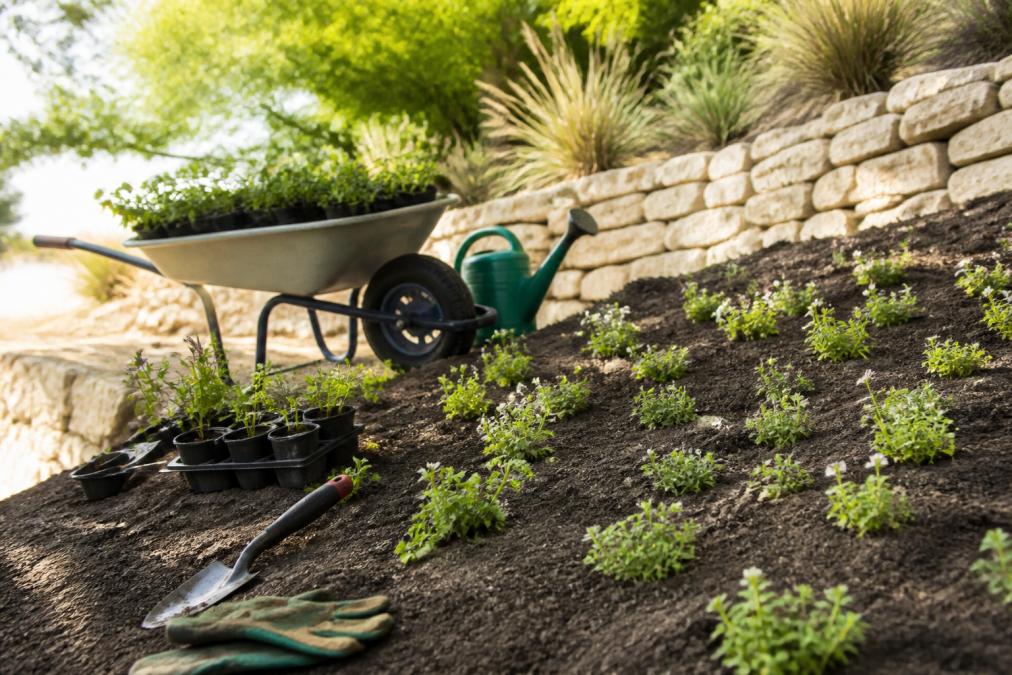
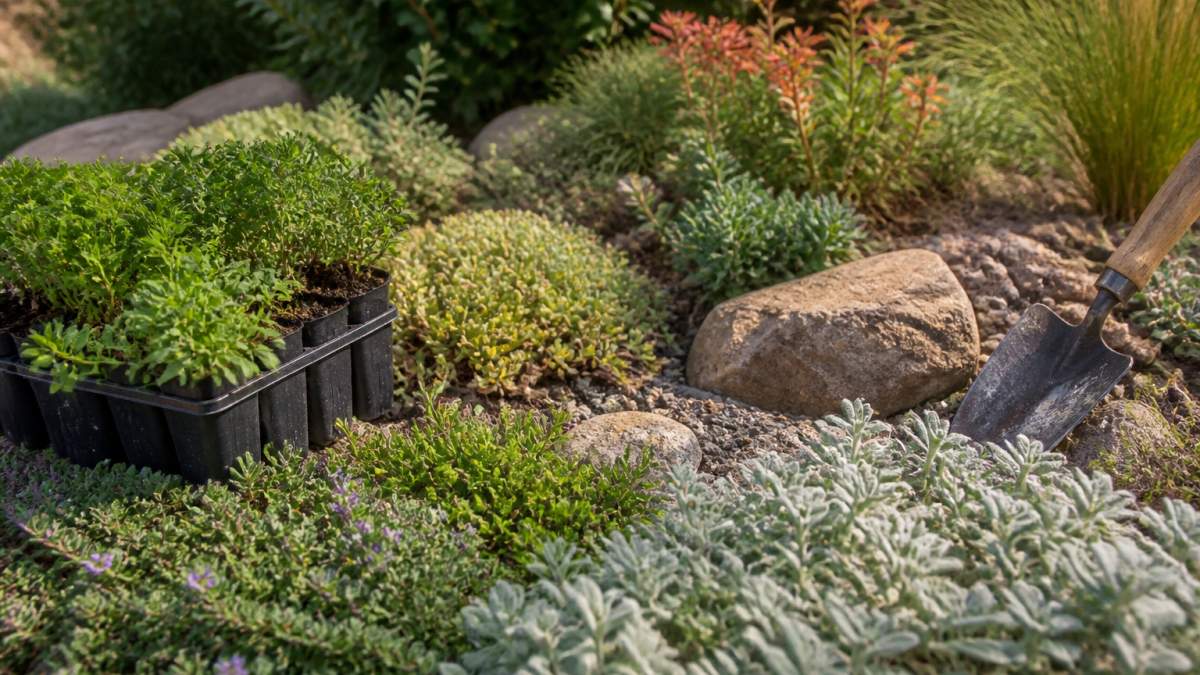
- Clear and test. Remove existing turf and weeds. Check drainage before planting anything.
- Amend only if needed. Native species generally prefer lean soil, so skip heavy fertilization.
- Plant on contour for slopes. Stagger plugs in offset rows so water can't run straight downhill.
- Space according to spread. Tight spacing costs more but closes the canopy faster and blocks weeds.
- Water deeply, then back off. Water at planting and through the first season, then taper to rainfall only.
- Mulch between plugs. This bridges the gap until the mat fills in.
Step-by-Step Installation for Erosion Control on Steep, Dry Slopes
Most guides mention erosion control and stop there. Here is the actual sequence for a slope too steep to mow and too dry to hold bare soil.
How to Choose the Right Native Ground Cover
Match the plant to the problem, not the other way around. Slope? Choose Beach Strawberry or Rocky Point Ice Plant. Foot traffic? Turkey Tangle Frog Fruit. Dry shade? Hummingbird Sage.
Frequently Asked Questions
What is the best drought-tolerant ground cover that spreads quickly?
Turkey Tangle Frog Fruit (Phyla nodiflora) spreads fastest among native options, forming a walkable carpet in a single growing season. Yarrow and Rocky Point Ice Plant also fill in rapidly on sunny slopes. For quicker coverage, plant plugs on 12- to 18-inch centers and water deeply through the first establishment period. Once roots settle, these native ground covers need little supplemental irrigation.
Which native ground covers require the least amount of water?
Rocky Point Ice Plant and Arizona Flattop Buckwheat top the list for water conservation. Both are desert-adapted, storing moisture in succulent leaves or woody stems and thriving on rainfall alone after establishment. Beach Strawberry and Creeping Phlox also perform well in well-draining soil with minimal irrigation. Match the plant to your hardiness zone and sun exposure for the lowest water use.
Can native ground covers replace traditional turf grass?
Yes. Walkable species like Turkey Tangle Frog Fruit and Beach Strawberry handle light to moderate foot traffic and form dense mats that crowd out weeds. They cut mowing, fertilizing, and watering compared with turf. Expect a short establishment period while roots knit together. For heavy-use lawns, mix walkable ground cover with paths or hardscaping to protect the plants.
How do I prepare my soil for drought-tolerant ground covers?
Test drainage first. Most native ground covers need well-draining soil, so amend heavy clay with compost and coarse grit. Clear weeds, loosen the top 6 to 8 inches, and grade slopes to slow runoff. On erosion-prone banks, install a biodegradable erosion control blanket before planting. Water new plugs regularly for the first few weeks, then taper off as plants establish.
Are native ground covers better for the environment than non-native alternatives?
Native species support local pollinators, birds, and beneficial insects that non-native plants often cannot. They also need less water and fewer chemicals once established, which supports biodiversity and water conservation. Plants like Hummingbird Sage and Yarrow feed native bees and butterflies. Choosing regionally adapted native flora keeps your landscape in step with the local ecosystem and reduces long-term maintenance.